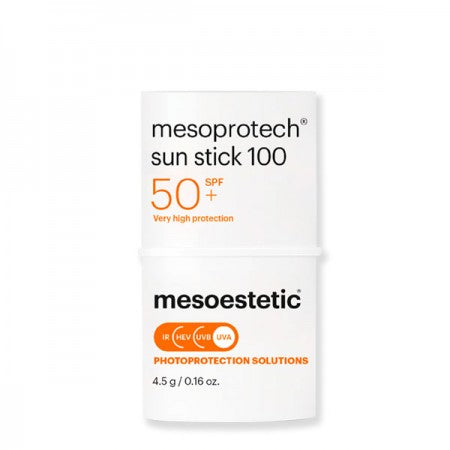
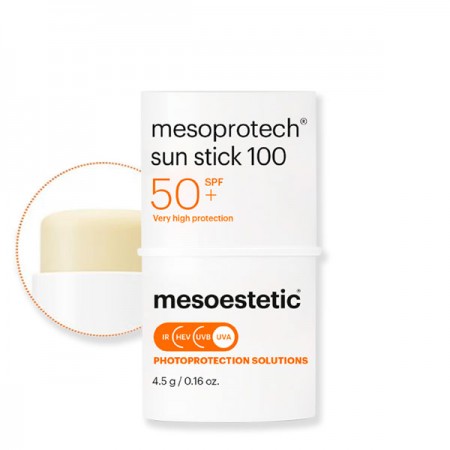
What is a facial sun stick
A facial sun stick is a sun protection format in solid bar form, designed to be applied directly onto the skin without needing to use your hands. It's become very popular because it solves a very specific problem: reapplying protection during the day without getting your fingers sticky or having to remove makeup. Its compact size means you can carry it in your bag or pocket, making it a practical ally for outdoor sports, travel, walks or any situation where the rest of your facial sun protection routine isn't within reach.
How to choose your facial sun stick
When choosing a stick, there are several aspects worth considering.
Protection factor
As with any sunscreen, for daily use an SPF 30 is usually enough, while for prolonged exposure or fair skin it's better to go up to SPF 50 or 50+.
Filter type
There are sticks with chemical filters, which absorb faster, and with mineral filters, more recommended for sensitive skin or skin prone to redness, since they work by forming a protective layer on the skin rather than penetrating it.
Area of use
Some sticks are formulated generally for the whole face, while others focus on specific and especially sensitive areas, such as the lips, nose, eye contour, ears, moles or sun spots.
Advantages of the stick format over cream
A facial sun stick doesn't require your fingers to apply, which makes it much quicker and cleaner than a traditional cream. It doesn't leave your hands sticky or force you to find a mirror or somewhere to wash up afterwards. It's especially useful for small or hard-to-reach areas, where a cream can apply unevenly, and it's perfect for reapplying over makeup without ruining it, since it glides over the skin without dragging your foundation or blush.
How to correctly apply a facial sun stick
For the stick to be effective, it's not enough to swipe it over the skin just once: you need to glide it several times over the same area until you create a visible, even layer. There's no need to press hard, as the warmth of your skin helps the product glide on and spread by itself. It's a good idea to repeat this motion on every area you want to protect, paying special attention to edges such as your hairline or the outline of your ears, where it's easy to leave gaps uncovered.
When to use a facial sun stick
The stick is especially handy for reapplying protection mid-morning or mid-afternoon without having to touch up your whole makeup, for protecting very exposed areas such as the nose or lips during outdoor activities, and for always carrying in your bag as a complement to the sunscreen applied in the morning. It's also a good option for children, since its quick, hands-free application makes things easier in moments of little patience.
Common mistakes when using a facial sun stick
The most common mistake is applying just one quick swipe, thinking the area is already covered, when in reality several passes are needed to achieve a real protective layer. Another frequent error is using it as the only product during long days at the beach or in the mountains, when its ideal role is to complement your facial sunscreen, not fully replace it over large areas of the face.
Facial sun stick for children and very sensitive skin
The stick format is especially comfortable for children's skin or very reactive skin, since it avoids direct contact between fingers and the formula and reduces the risk of transferring product into the eyes during application. Sticks with mineral filters tend to be the preferred choice in these cases, because they work by forming a film over the skin rather than penetrating it, which lowers the likelihood of irritation. Even so, it's always worth checking the ingredient list before choosing one, especially if the skin has a history of reactions to certain filters or fragrances, and doing a small patch test before applying it to the whole face for the first time.